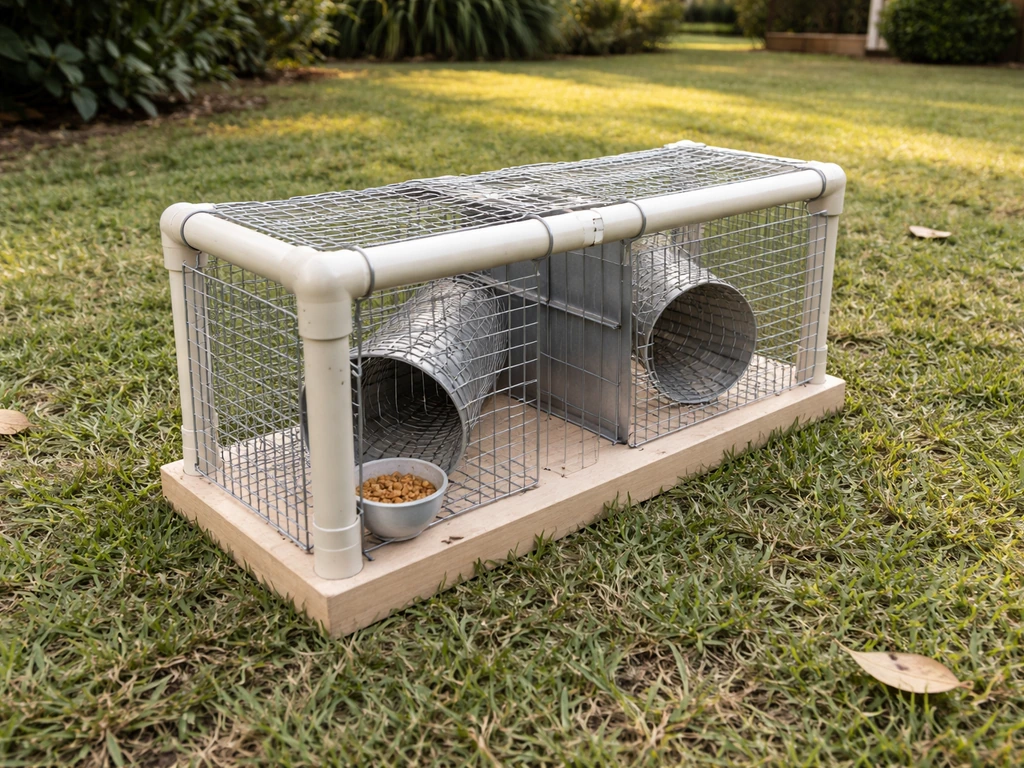
You can build a simple, humane DIY cage trap that live-captures Indian mynas using basic timber, wire mesh, and a one-way funnel entrance. The classic design is a two-chamber box: a feeding chamber that lures the bird in, and a containment chamber it passes into through a valve it cannot reverse through. Set it in a sunny open spot near where the birds already feed, bait it with pet biscuits or bread in small pieces, check it at least once a day, and keep pets and foot traffic away while it's running. That's the core of it, and the rest of this guide walks you through every step.
How to Make a Myna Bird Trap: DIY Indian Myna Guide
Marcus Thornton
13 May 2026
Why you might trap an Indian myna (and when not to)
Indian mynas (Acridotheres tristis), sometimes called common mynas, are one of the most damaging introduced species in many parts of the world. They aggressively compete with and evict native hollow-nesting birds and small mammals from their nesting sites, predate eggs and nestlings, and form loud communal roosts that make them a genuine nuisance in suburban backyards. There are real, documented reasons people want to manage their numbers: protecting local biodiversity, reducing noise, and limiting the health risks that come from a large flock fouling outdoor eating areas or water sources.
That said, trapping alone will not keep a myna population in check long-term. Research and local council guidance consistently note that unless you also cut off food sources and modify habitat (removing dense shrubs near roost sites, securing compost bins, not leaving pet food outside), birds will just move back in. Trapping makes the most sense as part of a broader management plan, not as a standalone fix.
There are also situations where trapping is the wrong call entirely. If you're dealing with a single bird that's claimed your garden for a week, it may simply move on. If you're not prepared to monitor the trap at least once daily and follow through with a humane outcome, don't set one. A trapped bird left unattended suffers, and a stressed bird inside a trap will give alarm calls that teach every myna in your neighborhood to avoid the whole setup. Know your 'why' before you build.
Legal and ethical basics before you build anything
This is the part most DIY guides skip over, but it genuinely matters. Wildlife law varies enormously by country, state, and even local council. In Australia (where Indian myna control is most actively managed), the species is generally classified as an invasive pest, and many councils actively encourage trapping programs. In the UK, the common myna is listed as a species of special concern under retained EU Regulation 1143/2014 and the Invasive Alien Species (Enforcement and Permitting) Order 2019, and you will need to check whether a wildlife licence applies to your intended activity. In the United States, taking or capturing wild birds can trigger both federal Migratory Bird Treaty Act obligations and state-level permit requirements, so check with your state wildlife agency (like your local equivalent of NYSDEC) before you build or deploy a trap.
The practical upshot: look up your local council or state wildlife authority's rules before you start. Many Australian councils (including those in Queensland and New South Wales) have published their own myna trapping guides and some even loan traps for free. Working within those frameworks means you have backup guidance if something goes wrong, and it keeps you legally covered.
On the ethical side, the non-negotiables are: check the trap at least once every 24 hours (more often in hot weather above 80°F/27°C or cold below 32°F/0°C), always provide water inside the containment chamber, provide shade if the trap is in direct sun for extended periods, and never leave a captured bird sitting in an uncovered trap where it can see predators and thrash against the wire. A review of trapping welfare notes that welfare depends on frequent checking intervals and minimizing trap stay, ideally visiting restraining traps as soon as possible after capture check the trap at least once every 24 hours. Cover the trap promptly after capture to reduce panic and self-injury. These aren't just kindness points, they also improve your capture success because a calm bird doesn't broadcast alarm calls.
Understanding myna behavior to pick the right location
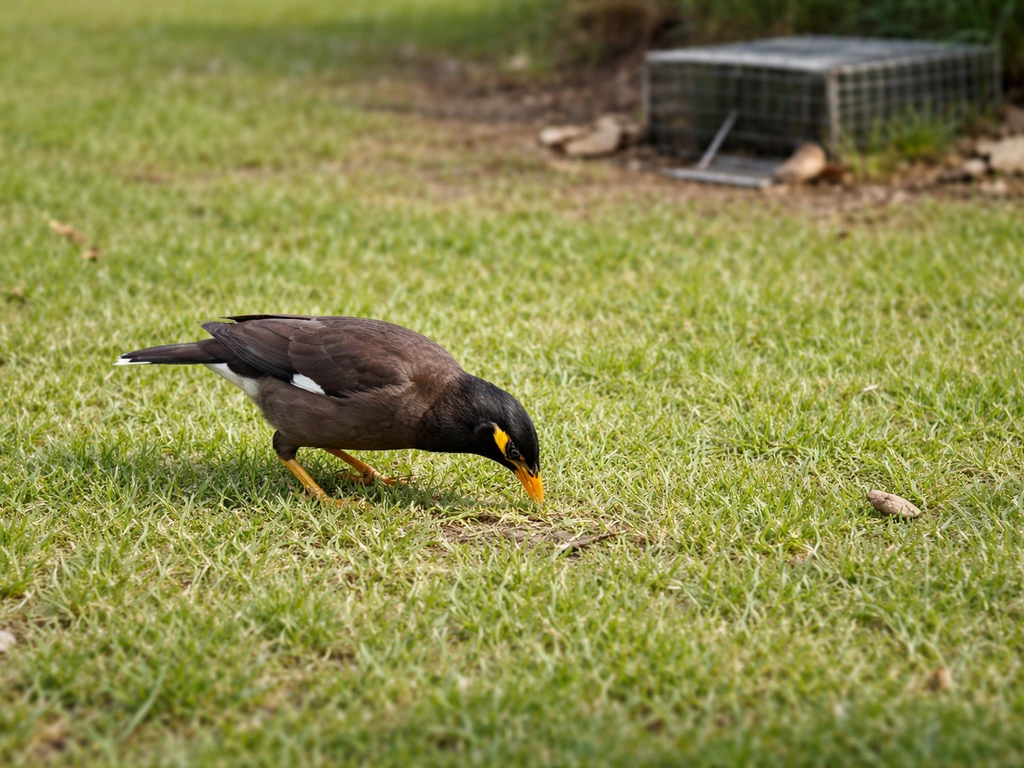
Indian mynas are day-active birds that roost communally at night. During the breeding season they're territorial and tend to operate in pairs near a nesting site. In autumn and winter, when food is shorter, they form larger foraging flocks. If you're trapping outside the breeding season you're more likely to catch multiple birds in a single setup session, while in spring and summer you may be dealing with a resident pair that's very familiar with your yard.
They're predominantly ground feeders, pecking food from short grass or bare ground. They're also bold and curious, which works in your favor when trapping, but they're also quick learners, which works against you if you make mistakes early. The key to placement: set the trap near where the birds are already foraging. Watch them for a day or two before you set anything up. If you can identify a regular feeding spot, that's where the trap goes. If you can't pin down a specific spot, the guidance I've seen from council trapping programs says to choose a location in full sunshine with at least a 3-metre clear radius around it, because mynas are genuinely uncomfortable feeding close to dense cover where predators might lurk.
The trap must be on private land and, ideally, not visible to the general public. That's both a legal consideration and a practical one: passersby who don't understand what the trap is for can accidentally disturb it or release birds. Keep pets well away from the trap area while it's active. A curious dog or cat investigating the cage will stress any bird inside, trigger alarm calls, and set back your whole program.
Your trap design options
For Indian mynas, the two main DIY approaches are a simple drop-door cage trap and the more effective two-chamber funnel-valve design (commonly called a 'Pee Gee' trap after a well-known Australian plan). I'd steer most backyard builders toward the two-chamber design, and here's why: a basic drop-door trap is faster to build but it either catches one bird at a time (and only if a trigger works perfectly) or it needs you nearby to drop the door. The Pee Gee-style trap uses a one-way funnel valve that lets birds walk from the feeding chamber into the containment chamber on their own, without any trigger mechanism. It can accumulate multiple birds over a session, it doesn't need you watching it, and the valve design greatly reduces the chance of catching non-target species like native birds.
A simple wire cage trap with a treadle or drop-door is fine if you want a fast build and are dealing with a single persistent bird. But if you're in Australia and managing an established myna problem, the two-chamber design is the gold standard recommended by council programs. The build steps below focus on that design because it gives better results for the time you invest.
| Feature | Simple Drop-Door Cage Trap | Two-Chamber Funnel-Valve Trap (Pee Gee style) |
|---|---|---|
| Build difficulty | Beginner | Beginner to intermediate |
| Time to build | 1-2 hours | 3-5 hours |
| Selectivity for mynas | Low (any bird can trigger it) | High (funnel size targets myna-sized birds) |
| Capacity per session | One bird | Multiple birds |
| Needs someone watching | Often yes (manual door) or needs trigger | No (passive valve mechanism) |
| Non-target risk | Higher | Lower |
| Best for | Quick single-bird catch | Ongoing population management |
What you'll need: materials and tools
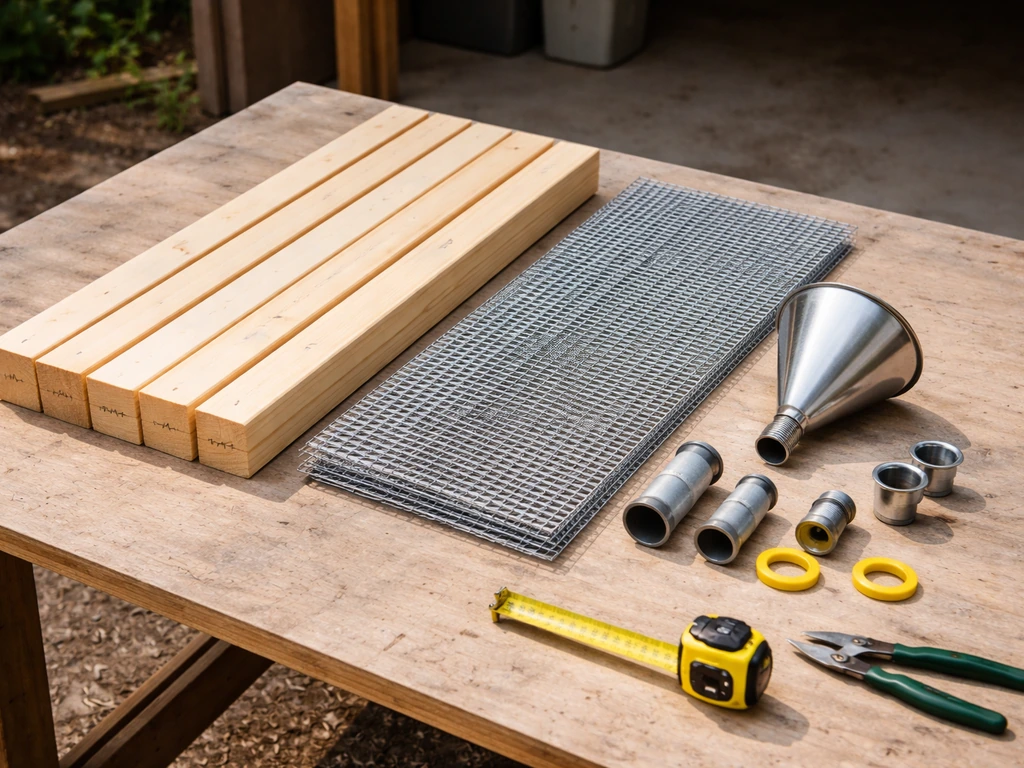
This list is for the two-chamber funnel-valve design, sized to comfortably hold several mynas. Most of these materials are available at any hardware store, and some can be sourced from scrap timber or repurposed wire. Don't let this list intimidate you, it's really just a box with wire walls and a smart doorway.
Materials
- Timber for the frame: 19mm x 44mm (or similar) pine or treated pine lengths, roughly 8-10 metres total
- Hardware cloth (welded wire mesh): 25mm x 25mm (1 inch) squares, galvanised, approximately 2 square metres
- Finer wire mesh for the funnel/valve assembly: 13mm x 13mm (half-inch) squares works well for the entrance tunnels
- Screws or staples: 25mm galvanised wood screws and a staple gun with heavy-duty staples for securing mesh to timber
- Hinges (x2) and a small latch or hook-and-eye for the access door
- A small water container (a jar lid or shallow plastic tray that won't tip easily)
- A short dowel or natural branch for a perch inside the containment chamber
- Roofing material for the top: a scrap of corrugated plastic sheeting, plywood offcut, or metal flashing (needs to provide shade and be weatherproof)
Tools
- Tape measure and pencil
- Hand saw or circular saw
- Staple gun (heavy duty, for wire to timber)
- Screwdriver or drill with bits
- Wire cutters or tin snips
- Pliers (for bending and securing wire edges)
- Safety gloves (cut wire edges are sharp)
Step-by-step build instructions
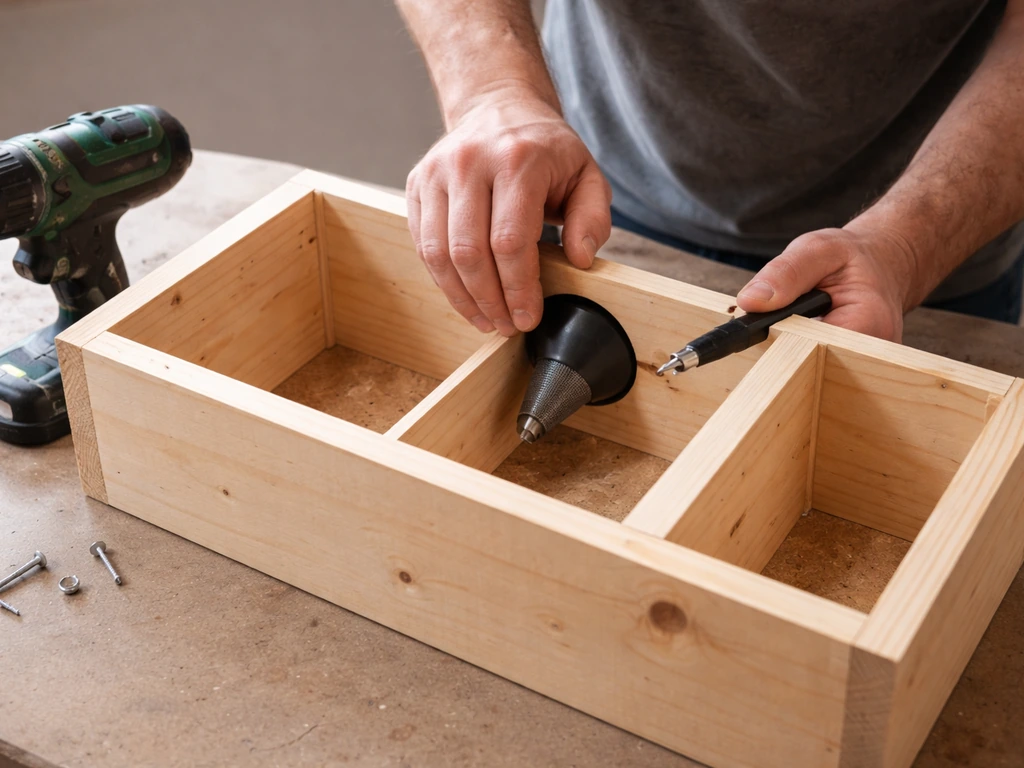
The trap has two compartments sitting side by side, sharing a central dividing wall with a one-way funnel valve through it. The feeding chamber is where the bait goes and the bird enters from the outside. The containment chamber is where the bird ends up after passing through the valve and cannot easily reverse back out. Total footprint I'd recommend: about 900mm long x 450mm wide x 450mm tall (roughly 35 x 18 x 18 inches). The feeding chamber takes up about 60% of the length and the containment chamber the remaining 40%.
- Cut your timber to form two rectangular frames: one for the feeding chamber (approximately 540mm x 450mm x 450mm) and one for the containment chamber (approximately 360mm x 450mm x 450mm). You're building simple open-sided frames, like the skeleton of a box, that you'll then cover with wire mesh.
- Assemble each frame using screws at the corners. Keep your joins tight. If you've got leftover timber off-cuts, add a cross-brace mid-span on any frame longer than 400mm to keep the wire mesh from sagging later.
- Cut wire mesh panels to fit all six sides of each chamber and staple them firmly to the timber frames. Work your way around systematically: floor, back wall, two side walls, then the top. Fold all cut wire edges back on themselves with pliers before stapling so there are no sharp points facing inward where a bird could cut itself.
- Build the central dividing wall (shared between the two chambers) out of wire mesh stapled to a shared timber frame. Leave a 100mm x 100mm opening in the centre of this wall to accommodate the funnel valve.
- Make the funnel valve: cut a cone-shaped or tapered tunnel from your finer (13mm) wire mesh. The wide opening faces the feeding chamber and should be just big enough for a myna to walk in (roughly 80-90mm diameter). The narrow end points into the containment chamber and tapers down to about 60mm. Bend the wire into shape and secure the edges tightly. The principle is the same as a wire-mesh crab trap or a live-fish trap: easy to enter, hard to exit because the bird can't easily find and re-orient through the small exit. Attach this funnel into the opening in the central wall and secure all edges so there are no gaps a bird could push around.
- Cut two small entrance tunnels into the outer walls of the feeding chamber (these are the entry points for birds from outside). Each should be about 75-80mm in diameter, positioned about 50mm above the floor so the bird has to step slightly up to enter, which helps exclude rodents. You can trim these holes round with wire cutters and smooth the edges with pliers.
- Add the access door on the containment chamber: cut a full-panel opening on one end wall and rehinge it with two small hinges so it swings open for you to retrieve birds or add water. Add a latch to keep it closed during operation.
- Attach the roof to both chambers: a single sheet of corrugated plastic or a plywood panel laid across the top and fixed at each end provides shade and keeps the trap dry. If your location gets direct afternoon sun, angle the roof slightly or add a second layer of mesh shade cloth on the sunny side.
- Fix a short perch (a 10mm dowel or a small straight branch) inside the containment chamber, running across the width about 100mm above the floor. Birds are less stressed when they have a natural place to land rather than just a wire floor.
- Place your small water container (a jar lid or shallow tray) in a corner of the containment chamber, wedged so it won't tip. This is non-negotiable for bird welfare once you have a capture.
First-time builders: the funnel valve is the part that trips people up. Make a test version out of scrap mesh first and check that you can fit your fist through one direction but not easily retract it. That's the principle. If the funnel is too wide at the narrow end, birds will exit easily and you'll catch nothing. If it's too narrow, they won't enter. Get this part right and the rest of the trap is just a wire box.
Bait, setup, and timing
Indian mynas are omnivores with a varied diet: fruits, grains, insects, nectar, and plenty of human food scraps. That makes bait selection easy. Dry pet biscuits (dog or cat kibble) and bread are the most commonly recommended baits by council trapping programs, and in my experience kibble is better because it stays put in light wind, doesn't mold as fast, and the birds genuinely love it. Keep bait pieces small, roughly 10-15mm, because a bird that can grab a large piece will fly away with it instead of lingering near the trap and exploring further.
Place a small white plate or light-coloured tray inside the feeding chamber with a small handful of bait on it. The colour contrast makes the food more visible to mynas from a distance. Then place a few individual pieces of bait just outside each entrance tunnel and a small trail leading up to it. Don't overdo the outside bait: if there's too much food available outside the trap, there's no incentive for the bird to venture in.
For the first few days, leave the funnel valve open or propped so birds can move freely in and out. This is the pre-baiting phase, and it builds confidence. Once you're seeing regular visits inside the feeding chamber, close the valve so it operates as designed. Some council programs also recommend gradually reducing other food sources in your yard (removing fallen fruit, securing compost) in the days before you start trapping, to make the bait inside the trap relatively more attractive.
Timing matters. Mynas are most active in the early morning and late afternoon. Set the trap up and check it at both those windows. In autumn and winter, when birds form larger foraging flocks, you'll have more foot traffic and faster results. During breeding season you may be dealing with a territorial pair who are suspicious of anything new in their territory, so expect a longer pre-baiting phase.
Check the trap at least once per day, ideally early morning and late afternoon. In temperatures above 27°C (80°F) or in direct afternoon sun, check more frequently, at minimum every few hours. Never attend the trap when mynas are actively present nearby or feeding inside the feeding chamber: if the birds see you approach and haven't committed, they'll learn to associate your trap with danger. Visit when the area is quiet.
What to do immediately after capture
When you find a bird in the containment chamber, cover the trap immediately with an old towel, hessian bag, or piece of shade cloth. A covered trap dramatically reduces the bird's stress response and stops it from thrashing against the wire and injuring itself. It also prevents alarm calls from reaching other mynas nearby.
Now you need to make a decision about what happens next, and this is where you should have done your legal homework beforehand. In most Australian jurisdictions, Indian mynas are classified as a pest species and the standard outcome recommended by council programs is humane euthanasia, typically by placing the covered trap in a sealed bag connected to a car exhaust, or by CO2 if you have access to it. Council trapping guides are frank about this: if you're trapping mynas for population control purposes, the expectation is that you humanely kill the captured birds. Catch-and-release elsewhere is generally not recommended because it just moves the problem, and in many cases releasing invasive species in a new area is actually prohibited.
If your local authority or jurisdiction supports a different approach (such as a relocation program to a wildlife sanctuary), follow their guidance. Some areas have organized programs where trapped birds are collected by local birdwatching or conservation groups. Check with your council first before you decide.
If you're dealing with a situation where you want live relocation (for example, you live somewhere where mynas are not an invasive species and you're just moving a problem bird away from a specific area), transport the covered trap to a release site at least 5-10km away, minimize handling time, and release the bird by opening the access door and stepping well back. Do not handle the bird with bare hands: mynas can bite and scratch, and wild birds carry bacteria that can cause infections.
After any trapping session, clean the trap thoroughly before reusing it. Remove all feces, scrub the wire and tray with warm soapy water, and let it dry fully. A clean trap doesn't carry disease residue and doesn't smell like a previous capture, which can deter new birds from entering.
Keeping the program going
A single trapping session won't solve a myna problem. These birds are smart, social, and there are usually more of them than you first realize. The most successful backyard programs I've seen run the trap for several weeks, combine it with habitat modification (removing food sources, trimming dense shrub cover near the house), and stay patient through the periods when birds go quiet. If you stop catching birds but still see them in the yard, try moving the trap to a new spot or refreshing the bait type.
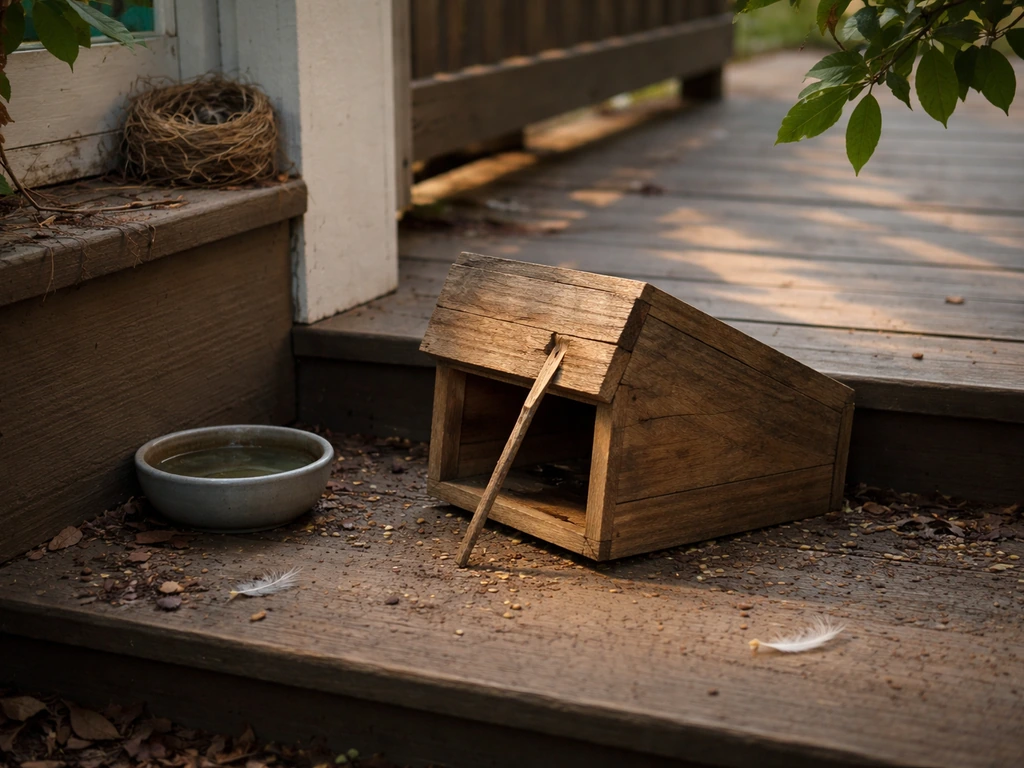
If you want to go further with automated or more sophisticated trap designs, there are options like automatic reset mechanisms that don't require you to reset a door after each catch. Those ideas overlap with concepts covered in guides on how to make an automatic bird trap, and if you're tackling a larger-scale myna problem on a bigger property that kind of upgrade is worth exploring. If you're looking for a net-based build instead, you can adapt the setup and placement tips from this guide to learn how to make bird trap with net. If you want more hands-off ideas, you can also watch a YouTube how-to for making an automatic bird trap and compare designs to this two-chamber approach make an automatic bird trap. If you're looking for the overall concept, our guide on how to make an automatic bird trap covers the key mechanisms and safety considerations how to make a automatic bird trap. Similarly, if you'd rather start with an even simpler proof-of-concept before committing to a full build, a basic live bird trap using a box and a stick is a useful starting point to understand the fundamentals before you move to the two-chamber design.
The bottom line: you can absolutely build a functional, humane Indian myna trap in a weekend with basic tools and a trip to the hardware store. If you want the same kind of approach, this also shows how to make a live bird trap safely and humanely build a functional, humane Indian myna trap. The build is genuinely achievable, the materials are cheap, and the design principles are proven. Get the funnel valve right, place the trap in the right spot, check it daily, and follow through with a legal and humane outcome for captured birds. That's the whole system.
FAQ
Do I need a wildlife license or permit even if my trap is “humane” and on my own property?
Often yes. “Humane” methods do not exempt you from rules about capturing or possessing wild birds. In many places, permits are triggered by the act of taking/capturing, not the cage design, so confirm with your local wildlife authority before building or deploying.
How long should I pre-bait with the funnel valve left open before closing it?
A practical target is 2 to 5 days, but extend if you do not see consistent visits to the feeding chamber. If birds are taking bait only from outside, keep the pre-baiting going, then close the valve once entry is habitual rather than exploratory.
What should I do if the trap catches native birds or other non-target wildlife?
Stop immediately and pause use until you can identify why the non-target species is entering. Common fixes include tightening tunnel dimensions, adjusting bait placement so only ground-foragers are drawn in, and reviewing whether the valve width and funnel angle are allowing easier exit for larger or agile species.
My mynas avoid the trap after a few catches, how do I troubleshoot?
Most avoidance comes from disturbances or incorrect valve performance. Recheck that the funnel allows entry but prevents easy reversal, ensure the trap area stays calm (no visits when birds are present), cover promptly after capture to reduce alarm behavior, and refresh bait and cleaning so there is no lingering capture odor.
Can I set the trap during the hottest part of the day or overnight?
Daytime heat increases the risk of heat stress and you must check at least once every 24 hours, more often in extreme conditions. Overnight trapping is also risky because you may not meet the monitoring requirement and the bird may sit longer while suffering, so schedule checks during your available window.
Does bait type really matter, or can I use any food?
Bait matters because mynas learn fast and will preferentially feed where food is easiest. Use small pieces that cannot be carried away easily, keep a modest amount outside the entrance to avoid “full meal” lure points, and stick to options that do not mold quickly if the weather is humid.
How do I keep pets from stressing captured birds or causing false alarms?
Use physical barriers and distance, not just supervision. Place the trap where dogs and cats cannot reach the wire walls, keep people away from the field of view, and consider blocking access paths so animals do not pace the cage, which can trigger panic and reduce your success rate.
Is it okay to relocate a captured myna instead of euthanizing it?
Relocation is frequently prohibited or restricted for invasive pests, and even when allowed it can be unethical if it spreads the same problem elsewhere. If relocation is an option in your area, follow the authority’s rules exactly (including approved distance and collection procedures) and minimize handling time.
What’s the safest way to handle a covered trap after a capture for transport or disposal?
Keep the trap covered until you are ready to move it, then carry it securely without shaking. Avoid bare-hand contact with the bird, prevent the cover from being lifted by wind, and if your plan involves transport for euthanasia, use sealed containment consistent with local guidance.
How should I clean the trap between sessions to avoid disease and odor issues?
Remove droppings fully, scrub wire and tray with warm soapy water, rinse if needed, and dry completely before the next use. Reusing a damp trap can leave lingering odors and can reduce attraction, and any residue can also increase health risks for both humans and animals.
If I stop catching birds but still see them around, what should I change first?
First, move the trap toward an active feeding spot rather than assuming they will keep using the original location. Second, confirm the valve and funnel dimensions are correct, because even small gaps can let learned birds exit easily. If those look right, refresh bait and re-evaluate whether other food sources in the yard are competing with the trap bait.
Next Articles
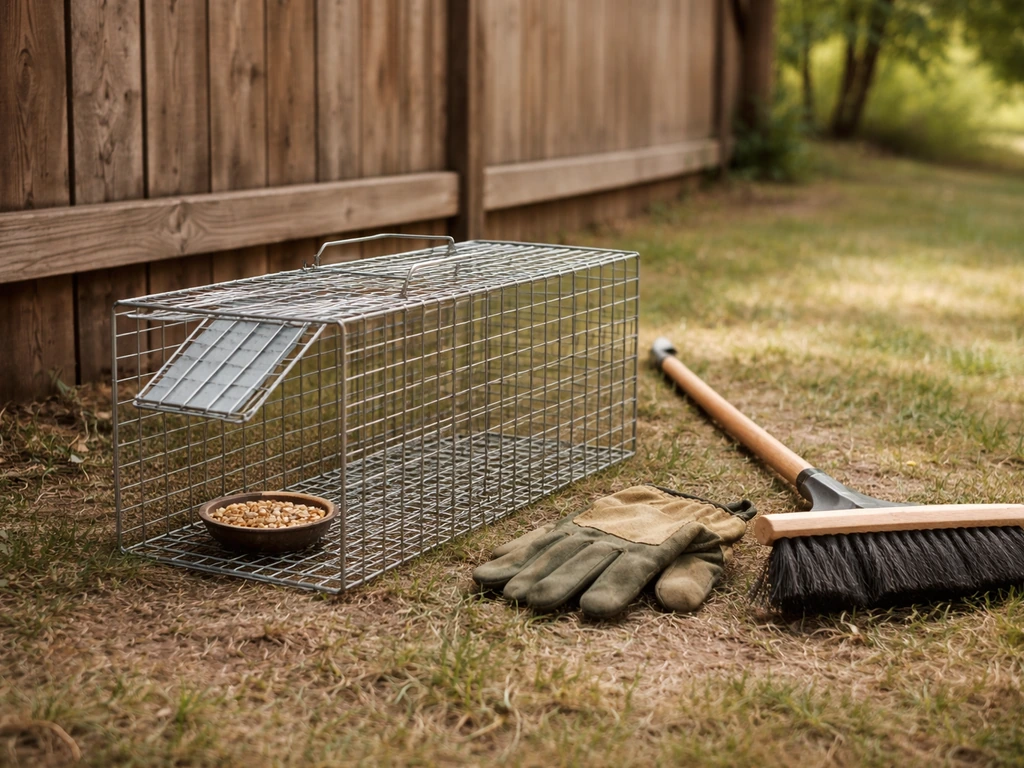
YouTube How to Make a Bird Trap: Safe DIY Steps
Humane, safe backyard bird trap DIY steps: when to trap, what to build, placement, monitoring, and release legally.
How to Build a Chimney Swift Bird House DIY Guide
Step-by-step DIY plans to build a chimney swift bird house, with correct dimensions, placement, and weatherproofing for
How to Build an Oriole Bird House: Step-by-Step DIY
Step-by-step DIY for building an oriole bird house with right dimensions, weatherproofing, predator-safe placement, and